Although oral diseases are largely preventable, they are among the most non-communicable diseases globally, and they disproportionately burden disadvantaged communities, specially within low- and middle-income nations. There is a shortage of dentist-scientist all around the world, especially in developing countries, such as Thailand.
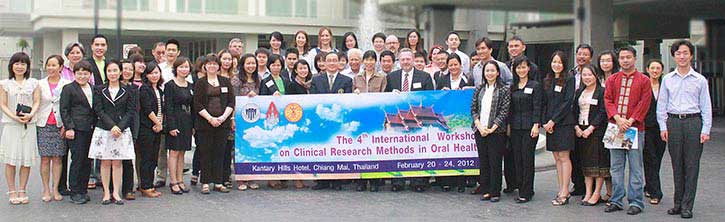
Thailand is an active member of the Association of South East Asian Nations interested in creating oral health research capacity and training. While governmental efforts towards increasing clinical providers have been successful, there has been a gap in the training and education required to create a cadre of dental researchers beyond clinical expertise, who would advance research that impacts public health.
For over 20 years, the University of Washington, School of Dentistry, has partnered with Thammasat University and Khon Kaen University to train a new generation of oral health researchers who have impacted the dental public health arena in South East Asia. As a result of this partnership, these institutions created the Fogarty International Center Training Program in Clinical, Public Health and Behavioral Oral Health Research for Thailand with assistance by the Fogarty International Center (FIC) and the National Institute of Dental and Craniofacial Research (NIDCR) (Grant Funding: D43 TW007768 and D43 TW009071, PI: DeRouen). By training over 200 trainees from 18 countries, this training site has brought Thailand to the international forefront of oral health research.
The training involved a combination of short, medium, and long-term pathways. Short-term workshops were five days and included general and scientific principles of planning and carrying out clinical research projects, clinical research, study design, statistical concepts, behavioral models, and ethical issues. Medium-term training involved attending the six-week Summer Institute in Clinical Dental Research Methods held at University of Washington in Seattle. The program was designed to provide a short but intensive research training program for dental school faculty and professionals interested in clinical research. Long-term training was designed to augment and strengthen oral health research pathways in existing PhD programs in Oral Science at Thammasat and Khon Kaen Universities. Trainees with English language skills spent one year in Seattle at University of Washington to a) take courses in biostatistics, epidemiology, or health services at UW School of Public Health, b) worked with one or more UW mentors on research projects they were developing to enhance their learning experience, or c) plan and finalize a dissertation research project that they would work on over the period of the next year in Thailand.
With the purpose to provide a perspective on the impact of the FIC and NIDCR support on creating training and research capacity in South East Asia, we conducted a survey of former trainees to inform us on their perception on how the Fogarty International Center Training Program in Clinical, Public Health and Behavioral Oral Health Research for Thailand impacted their professional paths. Most participants (74.3%) were enrolled in short-term training, 17.6% enrolled in medium-term training and 5.4% enrolled in long-term training. The perceived impact on how these training types influenced trainees at personal and at professional levels was assessed through open-ended question. Three major themes emerged, and responses were not exclusive: a) Improved knowledge of research methods (90.2%); b) Better equipped to teach and supervise students’ thesis and research (12.2%); and c) Connections made with other attendees (14.6%).
As a result of this unique training partnership, Thai universities have become the regional resource for oral health research in South East Asia. We believe this to be one of many models to be used to increase research capacity in global oral health for other low- and middle-income countries.
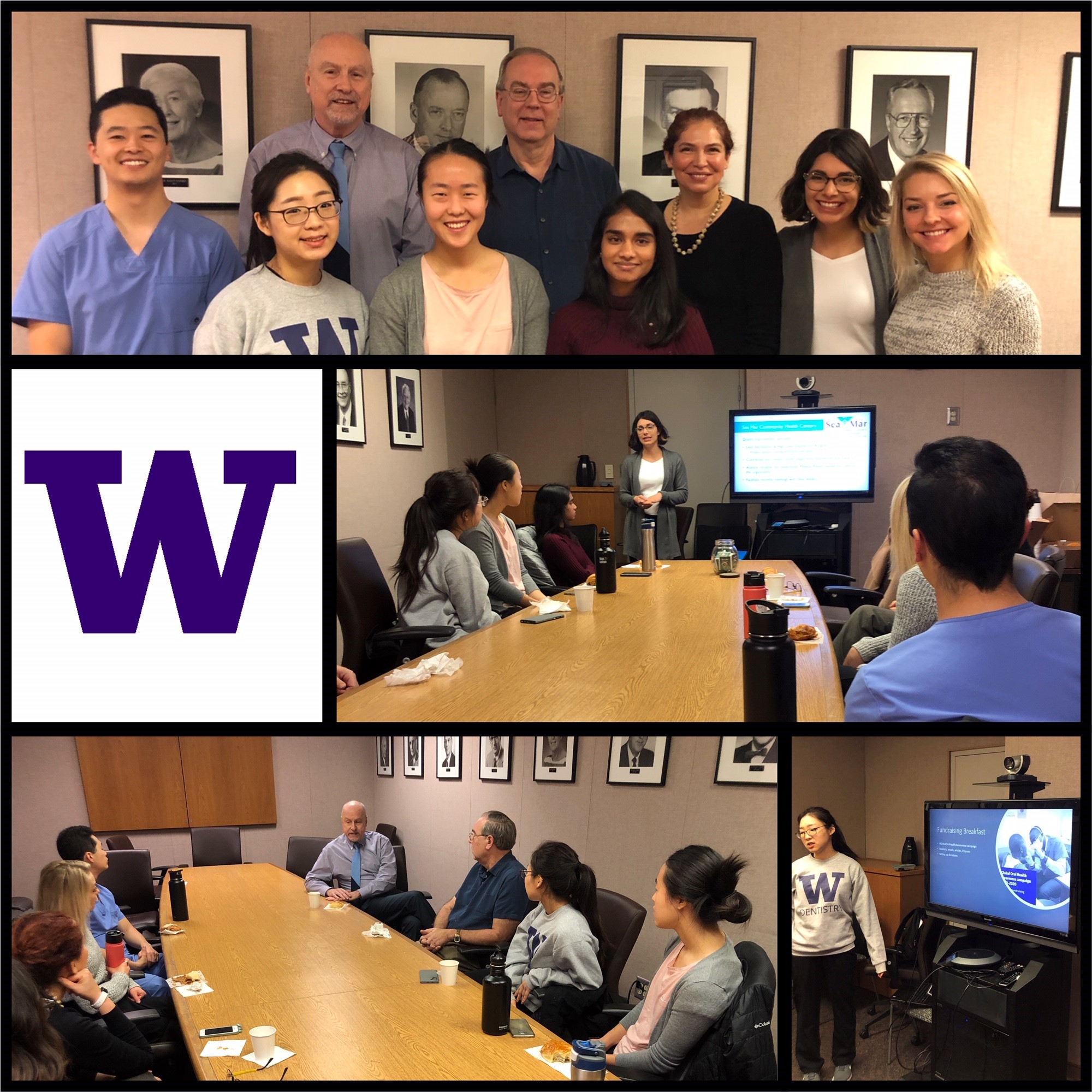 Our very first interns, Sydney Russell and Marina Martinez, presented their stories on early growth of various international sites in collaboration with the DeRouen Center, and also shared how their intern experiences have led them to their career path after graduation. After leaving UW, Marina worked as Senior Quality Improvement Specialist at Sea Mar Community Health Centers, and currently is a Business Operations Consultant at The Spur Group. Sydney is a Public Health Analyst with the Health Resources and Services Administration (HRSA) at DHHS.
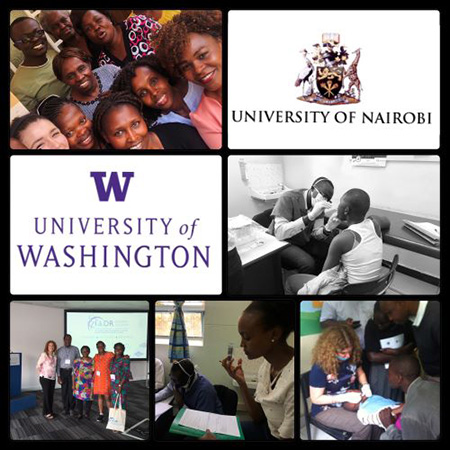 Since 2015, the University of Washington (UW) DeRouen Center for Global Oral Health has developed a partnership with UW Global Health, University of Nairobi and Kenyatta National Hospital in Kenya to set up the Children’s Healthy Oral Management Project (CHOMP). The CHOMP project investigates the connection between oral health and HIV. By developing research, training, and implementing pediatric oral health and HIV agenda, CHOMP sets an example for working towards improving oral health care for children with HIV. These partnerships not only advance oral health research, they also strengthen institutional collaborations which pave the way for future opportunities.

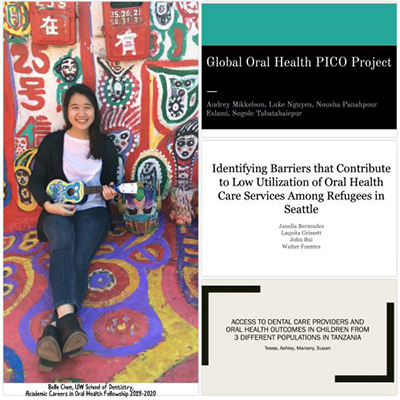 Dental students have demonstrated an interest in international topics but are largely unaware of global health topics. To improve students’ global health awareness, the University of Washington (UW) Timothy A. DeRouen Center for Global Oral Health at the UW School of Dentistry (UWSOD) created an elective course for dental and public health students. In 2018, UW began a partnership with Harvard School of Dental Medicine (HSDM) aimed to increase global oral health courses at educational institutions. Belle Chen (2020 graduate) received the 2019 Academic Careers in Oral Health Fellowship for her work in facilitating and developing the course integration. The result of this collaboration will be featured in Annals of Global Health, showing the effect on students’ knowledge and attitude towards global health.
 UW MPH graduate, Jennifer Liu, was recently selected for the California Epidemiologic Investigation Service (Cal-EIS) Fellowship Program for the 2020-2021 year. Cal-EIS is a unique program that provides one year of training in applied epidemiology for epidemiologists who have recently graduated from a Master’s degree program. Fellows have the opportunity to work on a variety of projects under the mentorship of a preceptor, either within the California Department of Public Health or within a local health department in the state. Prior fellows have performed studies on descriptive and/or analytic epidemiology of diseases, investigated disease clusters, and evaluated programs.
 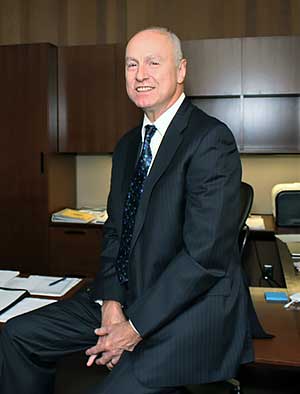 Life as we knew it has changed during the past few months, and it will never again be the same. The novel coronavirus seemed like a hypothetical risk when it arose in distant countries. Then the pandemic arrived in our back yard and began spreading here at great risk to public health. It is an invisible foe, highly contagious and significantly mortal. In the process of realizing the profound implications that a tiny virus has on our lives and freedom to move about in our communities, we are also confronted with the reality that dental education and dental practice will change forever. Our ability to gather large numbers of students in an enclosed space, and the wisdom of doing so, will be modified. The logistics of providing clinical experiences in dental schools and the facilities for that education will evolve. Patients, whether they access oral health care via private practices or dental schools, will arrive with new expectations and new questions. The technology that supports both educational methods and patient care must – and will — advance at a rapid pace. New vaccines and effective treatments will emerge with a high priority; however, these things will be effective against the enemy we know, not the ones that have yet to show up, and our patients and students will understand that limitation.
 The Northwest Center for Public Health Practice (NWCPHP) Student Collaborative Project Stipends are intended to help students defray living expenses during their hands-on public health training experience for public and nonprofit health organizations in Washington, Alaska, Idaho, and Oregon. These collaborative projects involve a faculty member and a student working in close collaboration to enhance public health services to medically underserved communities. Pooja Rajanbabu, one of our research assistants, has been awarded this stipend for her cross-sectional study entitled, “Evaluating Refugee Children’s Oral Health in Washington State.”